


The 51% gap: Why some of the UK’s over-qualified talent is being passed over by recruiters

If you discovered you had passed over a modern-day Albert Einstein or Isaac Newton for a role — and watched a competitor snap them up instead — how would that feel?
It sounds far-fetched, but Professor Simon Baron-Cohen of Cambridge University argues both men likely had Asperger’s syndrome. Autistic candidates are being screened out of roles every day, not because of a lack of ability, but because of a hiring process that was never designed with autism in mind.
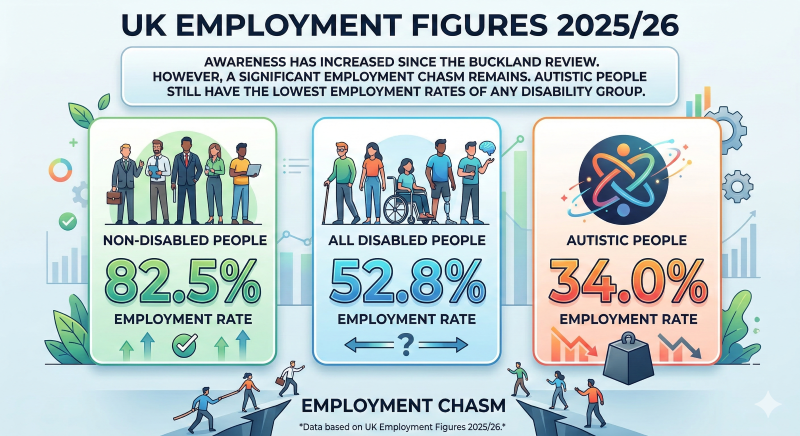
With only 34% of autistic people in employment, and 77% of unemployed autistic people actively wanting to work, the talent is there. The process is the problem.
77% of unemployed autistic people want to work. The barrier is not ability or ambition. It’s the lack of process. Read on to understand what needs to change, and what you can do about it today.
- If you work in recruitment, this article will show you exactly how to interview autistic candidates — and why fixing this process gives you a first-mover advantage on a vastly underutilised talent pool.
- If you are autistic and freelancing, or considering it, this article will show you why self-employment may protect you from a system with a 66% unemployment rate for people like you, and how to position your strengths to command better rates.
Finding a social niche
For years, the conversation about autism and work felt like an apology. Parents worried about their children making a living. Autistic professionals masked their true selves to survive strip-lit offices.
The true number of autistic people in England may be more than double the number often cited in national health policy documents, according to a UCL study.
So, if this affects you, how do you position yourself as a candidate when the job market is uncertain for everyone in 2026?
It is suggested by experts in autism that hiring managers must stop asking how workers on the autism spectrum fit into the market. Instead, they should ask how to build workplaces that embrace their unique talents for the advancement of the company.
Professor Simon Baron-Cohen of Cambridge University offers a powerful perspective on the topic. As mentioned earlier, he suggests Albert Einstein and Isaac Newton likely had Asperger’s syndrome. They succeeded by finding social niches.
In these niches, their strengths were valued more than their weaknesses. Arguably, the global economy would be more productive if everyone found such environments.
51% of autistic workers are overqualified for their roles and have the lowest employment rates among all UK disability groups. This means their skills and education are not being fully utilised by the UK economy.
UK employment figures 2025/26
Awareness has increased since the Buckland Review. However, a significant employment chasm remains. Autistic people still have the lowest employment rates of any disability group.
Workforce challenges for autistic workers
- Desire to Work: 77% of unemployed autistic people actively want a job
- Pay gap: Autistic workers earn roughly 28% less than non-disabled peers
- Qualification paradox: 51% of autistic workers are overqualified for their current roles
- Job security: Only 16% of autistic adults hold full-time, long-term roles
Systemic barriers still hold many back. Roughly 50% of managers report discomfort hiring neurodivergent staff. Traditional interviews rely on social nuance. This disadvantages technically superior candidates.
Furthermore, 69% of employers fear the cost of “reasonable adjustments”. In reality, adjustments like flexible hours often cost nothing at all.
The Buckland Review: Reasons for hope
The Buckland Review is the guiding document for reform in 2026. Major firms like Microsoft UK now prioritise neuro-inclusion. They realise an autistic analyst who sees hidden patterns is a massive asset.
Key government initiatives now include:
- The national “Autism-Confident” employer campaign
- Better access to “Access to Work” grants
- New “Autism Design Guides” for sensory-friendly offices
The rise of the autistic solopreneur
Traditional offices can be sensory minefields. Many autistic professionals now choose self-employment. This allows total control over lighting, noise, and social volume.
The Access to Work grant is a vital tool here. It provides capital for executive functioning coaches or business assistants. It helps autistic founders scale businesses that work with their neurology and unique talents.
Case study: Advocacy as a career from Andrew Arboe
The Freelance Informer came across an article by Andrew Arboe, who transitioned from the traditional education and non-profit sectors to founding his own freelance brand. Andrew found that traditional employment in the United States often left him feeling underutilised or overwhelmed by unspoken social hierarchies.
So, he decided to do something about that and launched a brand focused on specialised advocacy (including his local Driving with Autism initiative). He did this by turning his personal hurdles into professional talks, which he would eventually get paid for. Those talks then got him noticed, and he was contracted to help and guide research organisations. He also offered talks to parents through major milestones for their autistic children, so they wouldn’t feel overwhelmed and know where they could help.
Andrew’s tips for freelance success:
- Don’t just be a generalist. Andrew focused on driving and transition-to-adulthood—specific pain points in the community where he had lived experience
- Build an advocacy brand. Use your lived experience to teach others. Advocacy isn’t just speaking out; in 2026, it is a professional service that, for example, helps schools and businesses be more inclusive
- Control the interaction. Freelancing allows you to set the terms of communication—preferring emails or scheduled video calls over the “pop-ins” that disrupt autistic focus
A message to recruiters
Stop looking for a “culture fit.” Look for a “culture add” instead. Autistic specialists view problems through unique lenses. Read up on how you can ensure you do not pass on a candidate. They are essential for meeting new legal mandates, such as the European Accessibility Act.
Choosing the right path
The UK job market now offers two distinct paths for neurodivergent talent. Candidates might choose the structured support of a corporation, many of which have evolved to better interview, assess, and motivate autistic employees. Alternatively, they may prefer the autonomy and tailored environment of self-employment.
This choice is as individual as the spectrum itself, and both routes are more accessible than ever. However, while systemic barriers are fading, they have not disappeared entirely. To build the careers they truly want, autistic professionals may find their goals more attainable by acting as their own advocates and workplace educators—following the lead of self-advocates such as Andrew Arboe and high-profile figures like Elon Musk, actor Sir Anthony Hopkins and comedic actor Dan Aykroyd.