



"The industry can’t hire its way out of this gap fast enough; it’s simply impossible,” says Donatas Karčiauskas, CEO of Exergio
The energy sector’s reliance on a freelance and contractor workforce is growing. This report provides data on the income trends and specific roles in high demand
SPECIAL REPORT
Three-quarters of energy professionals worldwide say their sector is facing workforce shortages, a figure that rises to 90% in regions such as the Middle East and North Africa.
A new report from the Association of Energy Engineers (AEE) warns that demand for efficiency remains steady, but the people needed to deliver it are not available worldwide.
“The industry can’t hire its way out of this gap fast enough; it’s simply impossible,” says Donatas Karčiauskas, CEO of Exergio, an AI-based energy optimisation company focusing on commercial buildings. “And that is why AI is the only lever we can pull today to make an immediate difference while new professionals are trained.”
According to Karčiauskas, it can take years to train new specialists, but novel AI solutions and an agile freelance workforce can speed up the process.
Talent is retiring: who and what will fill the talent gap?
The AEE report warns the situation is worsening as over one-third of professionals plan to retire within the next decade. In North America alone, nearly a quarter expect to exit within five years.
At the same time, demand is not slowing. Despite global political turmoil and economic challenges, job opportunities for energy professionals remain consistent, the report reveals. Karčiauskas warns that this “invisible bottleneck” may be one of the reasons climate goals are slipping further out of reach.
AI-based energy efficiency tools can help facility managers do the job of many, which means job candidates should embrace new apps to become attractive candidates.
Karčiauskas explains,
In the past, one manager with a team would run a single hotel. Now a single manager oversees multiple buildings. Digitalisation is inevitable, but we need to speed it up.
He continues, “When we built Exergio, we saw that waste was often due to poor management practices, not outdated hardware. That’s where algorithms can deliver instant savings and help buildings become more sustainable, too.”
Energy reduction #1 priority
The AEE survey shows that energy reduction is the top strategic priority for 81% of organisations, a stable level despite wider market pressures. Yet almost half of companies still lack a decarbonization strategy.
For them, AI may provide a rapid starting point, Karčiauskas adds.
“Much of what wastes energy in the buildings can be automated through AI tools with human oversight. It would free professionals to focus on strategic tasks rather than daily micro-management. You would be surprised to see how many operations are run badly, even in newly built assets – only AI can spot these issues.”
According to the report, more professionals are warming to the technology. In 2025, 51% rated AI implementation as “extremely” or “very” important for efficiency.
However, some of the issues energy professionals face have been consistent over years. Government funding limitations are now a growing concern, reported by 46%, and budget pressures are back on the rise, cited by 73% of respondents, reversing last year’s improvement.
“With AI-based platforms, we’re solving two issues at once: the shortage of specialists and the high cost of deep renovations. Energy waste can be cut by up to 30% simply by letting algorithms optimise HVAC, lighting, and sensor systems. It’s far cheaper than tearing out hardware, and it works today. Especially when there are no experts to deal with it – we can’t just keep the buildings alone,” says Karčiauskas.
Talent and income expectations by region
The global energy market is not a monolith; income trends and talent demand vary significantly by location. For recruiters and contractors working in the energy sector or contemplating a career switch, understanding these geographical nuances saves a lot of time. According to the AEE:
- Energy service companies (ESCOs) and utilities report the highest hiring rates at 64% and 57% respectively, while manufacturing and institutional sectors show limited expansion plans below 25%
- Hiring patterns reflect operational realities across sector types. Service companies (ESCOs, utilities, consultants) consistently report higher hiring intentions, likely driven by project-based workloads and client demand.
- Manufacturing and institutional sectors show constrained hiring, potentially reflecting budget limitations and existing workforce adequacy.
Sasha Jaypalan, director and founder of recruitment agency Grace May, says rather than being set up as a limited company, individuals have been working through an umbrella company.
In an interview with industry news site Energy Voice, Jaypalan said, “I think people are resourceful, companies are resourceful, whatever obstacles are put in their way, I’ve just noticed organisations find ways to sort of keep the business going and keep things moving forward.”
The Grace May boss argued that IR35 “actually hasn’t impacted businesses that much,” however, it “probably has” impacted the growth of the economy.
The Banchory-based recruitment firm saw revenues reach almost £500,000 in the most recent financial year. The growth came from the energy sector.
Grace May is now placing more focus on renewables and looking at new verticals such as legal, human resources, and engineering.
United States
The US remains a power-hungry market. The market for Energy Storage Systems Engineers is particularly strong, with significant growth in states like North Carolina, Michigan, and Florida. The demand for Project Managers and Maintenance and Reliability Experts is also high, driven by new battery and solar plant construction. For financial roles, Grant and Funding Compliance Analysts and Cost Accountants are increasingly needed to manage federal investments. However, the Trump administration’s backlash over prexisiting climate change policies and investments has seen major wind power projects pulled in the US, leaving job security in limbo.
“A total of nine already permitted offshore wind projects that were set to provide electricity to nearly 5m households and create about 9,000 jobs in the US are under investigation or have already been paused by the Trump administration,” the Guardian reported.
In the same news report, it stated “Trump has barred any new solar and wind projects from federal land and waters, eliminated incentives for clean energy and, almost uniquely for a US president, called for an entire industry to be stopped in its tracks.”
Europe
Europe is a leader in energy transition, with a major focus on green technologies. Key roles in demand include Energy Project Engineers, Maintenance Engineers for Solar/Wind Plants (who have strong skills in SCADA and PLC), and Energy Efficiency Engineers. The continent’s emphasis on smart grids also creates opportunities for Smart Grid Specialists and Industrial Automation Engineers. Recruiters should note that proficiency in both technical skills and knowledge of EU energy regulations is highly valued.
Middle East
The Gulf region is experiencing explosive growth, driven by ambitious projects like Saudi Arabia’s Vision 2030. This is creating a massive demand for a broad range of engineers and project managers. Contractors should research if their home nation is creating bilateral startup initiatives which could offer project opportunities. Recruiters and startup hiring managers should look for talent with experience in large-scale infrastructure and MEP (mechanical, electrical, and plumbing) projects.
For example, in Seoul earlier this month, Korea’s Minister of SMEs and Startups, Han Seong-sook, met with Khalid A. Al-Falih, Saudi Arabia’s Minister of Investment, to discuss expanding cooperation in the SME and startup sectors. The bilateral meeting took place during Al-Falih’s visit to Korea for the “Korea–Saudi Vision 2030 Committee” and was arranged at his request.
- 2023: Launch of the Global Business Center (GBC) in Riyadh, providing office space and settlement support for Korean SMEs.
- Entrepreneur License Programme: Saudi Arabia introduced preferential treatment for foreign startups, with Korean companies among the beneficiaries.
- 2025: Introduction of a Korea–Saudi cooperation program to select promising SMEs in AI, bio-health, content, and smart cities, offering structured pathways into the Middle Eastern market.
Asia
While a rapidly growing market for renewable energy, Asia’s talent pool has not yet caught up. This presents a prime opportunity for Western professionals to work on a contract basis. The region is actively seeking expertise to meet ambitious growth targets, making it a great destination for experienced professionals seeking short-term, high-impact projects. The disparity in salary levels compared to other regions means that for businesses, contracting here can be a cost-effective strategy to gain essential skills.
Earning power in the energy sector
The average hourly earnings for contractors can fluctuate significantly based on these regional differences, as well as specific technical skills and project complexity. Recruiters should therefore benchmark their compensation offers with a keen eye on the local market and the specific role being filled. Here are some salary indicators by location.
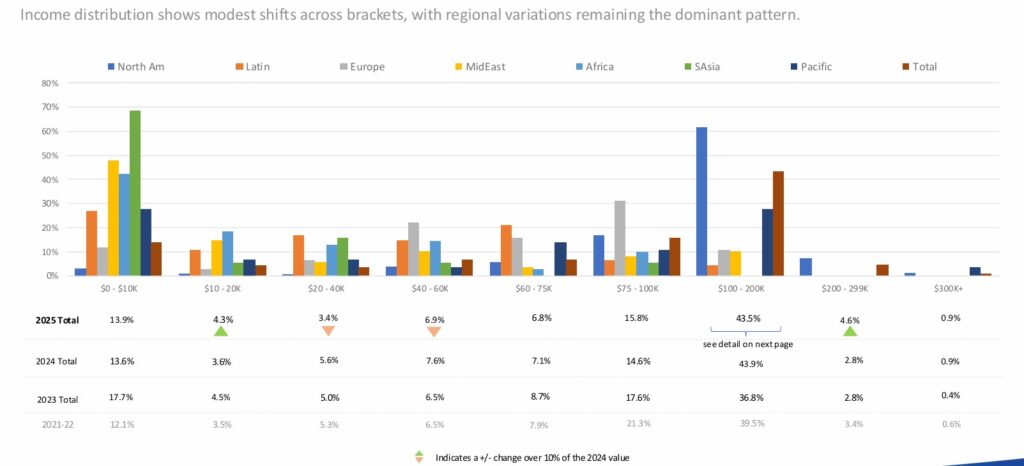
The table below shows the distribution of income among AEE members and non-members, highlighting the higher income prevalence among those with an AEE certification. 📊
| Income Range | AEE Member | AEE Member with a Certification | Non-Member with a Certification |
| $0 – $9,999 | 4.8% | 7.0% | 1.5% |
| $10,000 – $19,999 | 0.7% | 2.1% | 2.1% |
| $20,000 – $39,999 | 0.5% | 1.9% | 1.3% |
| $40,000 – $59,999 | 1.7% | 3.4% | 0.5% |
| $60,000 – $74,999 | 1.9% | 3.4% | 3.3% |
| $75,000 – $99,999 | 2.7% | 9.0% | 1.0% |
| $100,000 – $124,999 | 2.7% | 11.0% | 2.1% |
| $125,000 – $149,999 | 1.0% | 8.1% | 2.3% |
| $150,000 – $174,999 | 2.7% | 4.3% | 1.2% |
| $175,000 – $199,999 | 0.7% | 2.4% | 1.5% |
| $200,000 – $299,999 | 0.7% | 3.3% | 0.3% |
| $300,000+ | 0.5% | 0.4% | 0.0% |
Energy sector roles that in the high demand
Beyond location, certain roles are consistently in demand for freelance and contract work. This is the list of must-have professionals based on industry reports:
Energy and Renewables Engineers: This is a broad category, but the most sought-after include those with expertise in solar, wind, and battery storage systems. They are critical for the design, implementation, and maintenance of new projects.
Data and AI Specialists: With a growing need for data-driven decisions, roles like Data Analysts, AI/Machine Learning Engineers, and Business Intelligence Experts are crucial. They help companies forecast energy output, optimise operations, and track ESG performance.
Project and Construction Managers: As new infrastructure comes online, there is a constant need for experienced Project Schedulers, Construction Managers, and Design Technicians who can oversee large-scale construction projects, ensuring they are delivered on time and on budget.
Specialised Technicians and Experts: Specific roles like Wind Turbine Technicians and Offshore Tech Support Analysts are seeing massive growth. These are hands-on positions that require a deep, niche skill set and are well-suited for a flexible, contractor model.
Financial and Regulatory Experts: The influx of government funding and the increasing importance of ESG reporting mean that specialists like Grant and Funding Compliance Analysts and ESG Reporting Specialists are in demand on a project basis. They help companies navigate complex regulations and financial reporting requirements.
IR35 and the energy sector
With new umbrella company legislation set to take effect in April 2026 and the ongoing debate around a potential single worker status in the forthcoming Employment Bill, businesses are bracing for further disruption to the flexible workforce market.
Yet amidst this uncertainty, IR35 is now proving to be a safe haven, according to Dave Chaplin, CEO of IR35 tax compliance firm IR35 Shield.
“Eighteen months ago, the Public Accounts Committee (PAC) warned that HMRC’s “tough approach” was deterring companies from using contractors. Today, the environment is starting to look very different.
Chaplin explains what has changed, which could open so many more possibilities for clients who do not want to make permanent hires, but prefer an agile workforce for specific projects:
The dust has now settled on IR35. The Supreme Court clarified the legal principles a year ago, the offsets fix in April 2024 has removed disproportionate risks, and HMRC’s compliance teams are acting reasonably. Firms are passing checks quickly and cleanly, giving them the confidence to hire contractors again.
“It’s clear HMRC has listened and the risks for businesses have been dramatically reduced. Against the backdrop of new employment and umbrella reforms, IR35 is the one area where firms can now hire with certainty.
“For the first time in 25 years, IR35 is seen to be working in practice. My advice to policymakers would be to avoid tinkering with tax and let the stability hold – especially now, when businesses need certainty more than ever.
The shift to a project-based workforce is already a rising trend in the tech sector, which is quickly replicating in other industries, including energy. By targeting these specific roles in high demand and understanding the geographic income trends, freelancers can proactively work with recruiters or directly with energy startups and larger firms to pitch a project proposal.
Related articles: Want to future-proof a career in offshore wind?
