


Jobs safe from automation in 2026: the hands-on, people-focused roles standing firm against AI

According to Palantir CEO Alex Karp, the future job market will cater to just two types of people. “Essentially, there are two pathways to ensure your future,” he said on the TBPN podcast on March 12. “One: you possess specialised vocational training. Or two: you are neurodivergent.”
Many readers may argue that this viewpoint is obstinately narrow. Incidentally, it is also not a shared opinion by some of the C-Suite executives who run the companies that make up Palantir’s largest shareholders.
So, what does that tell us? AI scaling and development are still highly dependent on mass institutional funding. Then there are the data centre energy bills to be considered. If the financial plug on AI is pulled, for any variety of reasons, the world will still need more than just tradespeople and neurodivergent workers to make the world economy work for the majority, not just the minority.
That said, AI momentum as it pertains to hiring practices in 2026 cannot be ignored. It’s career suicide to do otherwise. That’s why, alongside Karp’s messaging, we looked into a report by construction planning software platform Planera. The report offers a more nuanced picture of automation risk in the job market than the headlines suggest. Analysing more than 55 manual and trade-based professions, the research identifies which jobs are safest from automation and why many of them also offer strong self-employed and freelance potential in the UK.
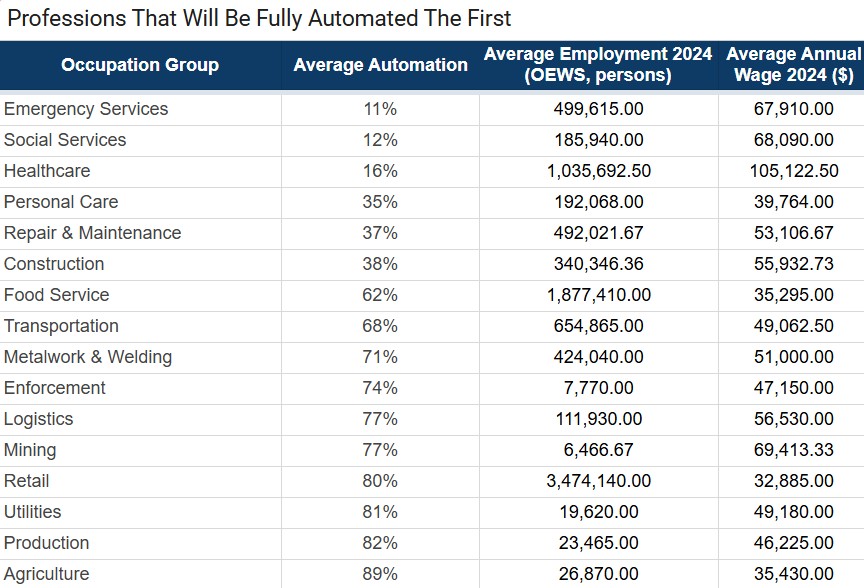
While sectors such as agriculture (89% automation risk), construction (38%), and parts of healthcare (16%) face significant disruption, many essential roles remain firmly rooted in human capability and are growing in demand as a result.
Which jobs are safest from automation in 2026?
The Planera report reveals that the jobs most resistant to automation share three core traits: hands-on physical skill, adaptive problem-solving in unpredictable environments, and meaningful human interaction. Repetitive or highly predictable tasks remain the most vulnerable; complex, empathy-driven roles are far harder to automate. In many cases, the latter are becoming more valuable.
The following data, provided by Planera and based on a 2024 US survey, shows a promising future for some trades, but a dire picture of unemployment for so many.
Emergency medical technicians: the most automation-resistant profession? It depends on where you live!
Emergency medical technicians (EMTs) top the list with an automation risk of just 7%, which is the lowest of any profession studied.
As first responders, EMTs must assess complex medical situations in real time, make rapid decisions under pressure, and deliver immediate care. These tasks rely on human judgement, dexterity, and emotional awareness: qualities that machines have yet to replicate effectively.
Despite their critical importance, EMTs are the lowest-paid among the ten most secure professions, earning a median annual wage of $41,340 (approximately £32,500). Nevertheless, demand for these roles continues to grow, underscoring their enduring value to society.
However, while automation is one less thing EMTs in the US have to think about, paramedics, who usually have deeper medical training than EMTs, must worry about budget cuts. The BBC reported that newly qualified paramedics in Wales have been encouraged to apply for jobs abroad due to a hiring freeze.
Students in their final year of paramedic science degrees contacted BBC Your Voice to say they have been advised to apply for jobs in Canada, New Zealand and Australia, with one calling the move “crazy and shortsighted”.
Carl Kneeshaw, from the Wales ambulance service, said it was “navigating a difficult financial and operational landscape”.
Firefighters and first responders: why machines can’t replace human judgment
Firefighters follow closely with an automation risk of just 9%. For example, with over 332,000 firefighting professionals employed across the United States alone, it remains one of the most human-dependent occupations in the world. The unpredictable and hazardous nature of emergency response makes automation impractical, ensuring long-term job security in the sector.
Social care and healthcare roles: the power of empathy
Social services represent the second most automation-resistant sector overall. Healthcare social workers rank third in the study, facing a modest 12% automation risk. Their work, which involves supporting vulnerable individuals and navigating complex social and emotional challenges, relies on interpersonal skills that technology continues to struggle to emulate.
Registered nurses and nurse anaesthetists also feature in the top ten, with relatively low automation risks. Around 22% of nurses and patients surveyed expressed concern about potential job losses in this area, reflecting wider anxiety around automation even in relatively secure fields.
Police and patrol officers appear prominently too, with a 13% automation risk. Whilst certain administrative tasks within policing may eventually be automated, core responsibilities — maintaining public safety and making split-second decisions — remain firmly human.
Skilled trades: electricians, plumbers and HVAC technicians
Among the construction trades, electricians stand out as particularly secure, facing just a 14% automation risk. Demand for skilled electricians is rising rapidly, driven by ageing infrastructure, the expansion of electric vehicle (EV) charging networks, and the global energy transition.
According to the UK Trade Skills Index via MyJobQuote, an additional 104,000 electricians will be needed by 2032 to fill the growing skills gap — with experienced self-employed electricians already earning in the region of £52,000 per year.
There is a striking irony here: the very technologies fuelling automation — including AI data centres — depend heavily on electricians to be built and maintained. In this sense, the role is not only safe from automation, but it is also essential to its future.
Plumbers and HVAC technicians round out the skilled trades contingent, both featuring low automation risks driven by the physical complexity and variability of their work. These are roles that no algorithm can perform remotely.
Construction and carpentry: physical skills that machines struggle to replicate
Carpenters also appear in the top ten most secure professions, with automation risks in the 14–25% range. These roles share a common thread: hands-on work, dynamic problem-solving, and a reliance on physical presence and skill that current robotic technologies cannot yet match in real-world conditions.
For self-employed readers: Six of the ten professions in this report have a well-established freelance or sole-trader pathway in the UK — making them among the most future-proof options for anyone working independently.
Six of these jobs you can do as a freelancer or sole trader
For the UK’s growing community of self-employed and solo workers — now numbering around 4.4 million as of early 2025, according to Statista — the findings of this 2026 report carry particular significance. Of the ten most automation-resistant professions, six have a strong and well-established self-employed dimension in the UK.
Electricians and plumbers are among the most naturally self-employed trades in the country, with many operating as sole traders or limited company owners.
Carpenters and HVAC technicians similarly enjoy a strong freelance and subcontracting market, particularly in new-build, retrofit, and renewable energy projects.
Healthcare social workers increasingly operate in private practice or on a locum basis. Registered nurses, meanwhile, can work through NHS and private sector agency or locum arrangements — a well-trodden route to flexible, self-directed working.
The remaining four professions in the top ten — EMTs, firefighters, police officers, and nurse anaesthetists in structured hospital roles — are predominantly employed positions with limited freelance pathways in the UK.
What self-employed tradespeople earn in the UK in 2026
The earning potential for self-employed tradespeople in the UK is considerable. According to Learn Trade Skills, self-employed electricians earn in the region of £60,000 per year pre-tax, based on a typical day rate of around £320. MyJobQuote reports that self-employed plumbers earn approximately £65,000 pre-tax annually, with limited company owners commanding closer to £73,000.
Construction is the single largest sector for self-employment in the UK, with approximately 745,000 self-employed workers as of Q3 2024, according to Statista — more than any other industry. For anyone weighing up a self-employed future in the trades, these figures — combined with low automation risk and rising demand — make a compelling case.
For recruiters and hiring managers: The roles safest from automation are often the same roles with acute talent shortages. Understanding this dynamic is essential to building a proactive hiring strategy in 2026.
What this means for recruiters: the hardest roles to fill are also the safest from automation
For recruiters and talent acquisition professionals, the 2026 Planera report presents both a challenge and an opportunity. The roles least vulnerable to automation — skilled trades, emergency services, and social care — are precisely the roles experiencing the most acute talent shortages in the UK.
According to the UK Trade Skills Index, the country needs an estimated 104,000 additional electricians by 2032 to meet government housebuilding and renewable energy targets. The Chartered Institute of Plumbing and Heating estimates a shortfall of 73,700 plumbers over the same period. These are not abstract projections — they represent immediate and growing pipeline pressure for anyone placing talent in these sectors.
Several factors are reshaping the recruitment landscape for these roles. Candidates in automation-resistant trades have growing leverage: they know their skills are scarce, their work cannot be offshored, and their long-term job security is strong.
Recruiters who lead with this narrative, framing a role’s automation resistance as a genuine selling point, will have a distinct advantage in competitive candidate markets.
Emerging specialisms are also creating new hiring niches. EV charging installation, heat pump engineering, solar panel fitting, and AI data centre construction are driving demand for electricians and HVAC technicians with specific technical certifications.
Platforms such as Indeed UK already show active demand for self-employed electricians specialising in heat pumps, with day rates of up to £400 reported for experienced installers. Recruiters who map these specialisms proactively — rather than waiting for vacancies — will be better positioned to serve clients in the energy transition.
Finally, it is worth noting the IR35 and self-employment dimension. Many tradespeople in these sectors operate as self-employed contractors or subcontractors.
As reported by Mode Insurance, from April 2026, employers will become responsible for paying the correct income tax and National Insurance contributions for umbrella company workers. This is a significant change in the compliance process whereby recruiters placing contractors in construction, facilities management, and social care must understand and communicate clearly to clients.
What makes a job resistant to automation?
The research points to several consistent factors that protect roles from automation.
- Physical dexterity in unstructured environments matters enormously: robots excel at repetitive, precise tasks in controlled settings but struggle with the variability of real-world manual work
- Emotional intelligence and communication remain beyond AI’s reach for roles requiring empathy, active listening, and nuanced human interaction
- Complex, contextual decision-making: Where workers must rapidly assess unique situations and adapt, as first responders and social workers do, demands a level of judgement that machines have yet to master
- Regulatory and safety considerations also play a role: many hands-on professions, particularly in healthcare and emergency services, are governed by frameworks requiring certified human oversight
The future of work: the human edge in an automated world
What emerges clearly from the Planera report is that automation is not simply about replacing jobs — it is about reshaping them. Roles that require adaptability, empathy, and physical presence are proving difficult to automate, and in many cases are becoming more valuable as AI advances elsewhere in the economy.
As industries evolve, the human edge is emerging as a powerful safeguard against displacement. Whilst machines may take over repetitive or predictable tasks, the complexity of real-world environments — and the people within them — continues to favour skilled human workers.
For self-employed tradespeople, locum healthcare workers, and the UK’s growing community of solo professionals, the message from this report is a reassuring one: the future of work still belongs to those who can think on their feet, work with their hands, and connect with others in ways no machine can replicate.