


British creators are all too happy to translate China’s brand boom

As Chinese corporate giants scale up their UK presence, a new hiring trend is brewing. Rather than working through traditional ad agencies, some brands are looking to bypass the middleman. They are opting instead to build a localised army of independent freelancers and affiliates to help weave their products into British consumer culture. And by looking at shop queues, it’s working
I remember turning over a toy doll as a child and reading the embossed words ‘Made in Taiwan’. Curious, I began checking the rest of my toys. Sure enough, most of them hailed from this faraway land. I may not have fully grasped the concept of overseas licensing and manufacturing at the time, but I did notice that the brightly coloured boxes these toys arrived in often bore a different name, like Mattel.
Today, ‘Made in China’ is the phrase most children see stamped onto their plastic moulded toys. China now produces between 70% and 80% of the world’s supply. However, where factories once quietly assembled overseas designs, Chinese creators are now building their own global brands.
Chinese brands are moving beyond marketplace success and focusing on trust, brand building, and international expansion – with affiliate partnerships playing an important role.
-Tradedoubler
Names like Pop Mart, Luckin Coffee, and Heytea are arriving on British high streets, armed with deep pockets and aggressive digital apps. According to the Retail Gazette, Pop Mart recently opened a massive new flagship store on Charing Cross Road, marking its 16th location in the United Kingdom.
On any given afternoon in Soho, it is not uncommon to witness a queue of teenage PopMart or Miniso shoppers snaking around the block. These young consumers are not waiting for a new trainer drop; they are waiting to buy highly coveted toys designed in Beijing (and soon the UK and Europe).
The Retail Gazette explains the phenomenon:
Best known for characters such as Labubu, Molly and Skullpanda, POP MART carved out a niche that blends artist-led intellectual property, major brand collaborations and the repeat-purchase power of the blind box format. That unique combination helped turn its products into fully fledged fandoms, fashion accessories and pop culture collectables, with particular resonance among Gen Z and millennial shoppers.
Driven by social platforms like TikTok, young consumers are craving these Chinese creations. To sustain this momentum, the companies behind them are turning to British and European creatives—as well as individual affiliate marketers—to keep the buzz alive and create brand loyalty.
For local freelance copywriters and social media managers, this should spark a lucrative project pipeline. So, where are the jobs? And what other brands and sectors should be on freelancers’ radars?
ABL recruitment reported professional services, particularly HR and legal, are likely to see “immediate demand”:
As Chinese companies establish UK operations, they require support with compliance, employment law, organisational design, and immigration, creating a steady pipeline of specialist roles.
Banking and finance opportunities in London will continue to “act as a gateway for Chinese firms seeking international financial access”, said ABL Recruitment. Adding:
Notably, fintech was the most popular Chinese investment sector in 2023, with over £500 million in aggregated transaction value, signalling continued demand for roles in compliance, payments, and financial technology.
Retail
Urban Revivo, also known as the “Zara of China”, is a fast-fashion brand aggressively moving into brick-and-mortar. They’ve secured a 30,000-square-foot flagship at Westfield Stratford City, coupled with a highly visible high-street presence on Neal Street in London’s Covent Garden.
Miniso offers affordable, design-focused lifestyle goods and major intellectual property (IP) collaborations. Miniso is rapidly multiplying across UK high streets and shopping centres, leaning into experiential, large-format stores.
Coffee & Tea Roasters
According to Xinhua, speciality Chinese coffee roasters, including Shanghai-born Terraform Coffee Roaster and tea chains, are using London as their European launchpad, targeting design-conscious Gen Z consumers.
Auto Tech
BYD (Build Your Dreams) is an automaker competing directly with traditional European legacy brands, trading from over 130 UK retail sites (aiming for 150). Some car dealership chains have replaced traditional US motor brands with BYD.
Chery Group (Omoda & Jaecoo) have its first European HQ in Liverpool. Their mid-sized SUV, the Jaecoo 7, actually topped the UK charts as a best-selling vehicle, deeply embedding itself into national dealership networks like LSH Auto and Peoples.
How are Chinese brands winning consumers over?
For years, Chinese e-commerce was defined by sheer volume. Giants like Shein and Temu flooded global e-commerce with low-cost, algorithm-driven goods. This new wave of brands wants something different: they want to be loved in the same way big American and European brands have been for decades.
But how are these brands drawing new customers so quickly? What’s their formula?
Their marketing formulas vary. Luckin Coffee, for example, draws crowds by offering substantial discounts through its mobile app, which is a playbook that has pushed its footprint past 31,048 locations globally, notes StoneX. Meanwhile, Pop Mart relies on viral trends, such as its popular Labubu plush dolls, to turn niche toys into high-street hits.
However, managers based in Shenzhen or Shanghai do not always know what resonates with a teenager in Manchester. Or how long they can keep their attention and brand loyalty. Small mistakes in tone can ruin a brand’s reputation.
Ian Ashton, Pop Mart’s Head of UK Retail, told the Retail Gazette that their new stores are meant to connect deeply with local culture. To build that connection, these businesses need a native voice.
Who holds the purse strings?
First, there are cross-border agencies such as Hylink Digital. Acting as intermediaries, they take the core strategy from China and hire local experts to execute the creative work.
Historically, these agencies focused on helping major US and European brands enter the Chinese market. Now, they are helping massive Chinese enterprises localise their digital campaigns, SEO, media buying, and influencer strategies across the UK, US, and Europe. They operate out of major global hubs, including Beijing, Shanghai, London, Los Angeles, Paris, and Munich.
Second, the brands themselves are cutting out the middleman. Many are building small, dedicated teams directly within the UK and Europe. A report by affiliate marketing company Tradedoubler confirms this trend, noting that Chinese companies want long-term trust and visibility in Europe. They are actively hunting for local creative partners who command instant credibility.
“Chinese brands are moving beyond marketplace success and focusing on trust, brand building, and international expansion – with affiliate partnerships playing an important role,” Tradedoubler reported, adding: “For advertisers and publishers in Europe, this brings both new opportunities and growing competitive pressure.”
Jobs for creatives, but not as many as they’d like
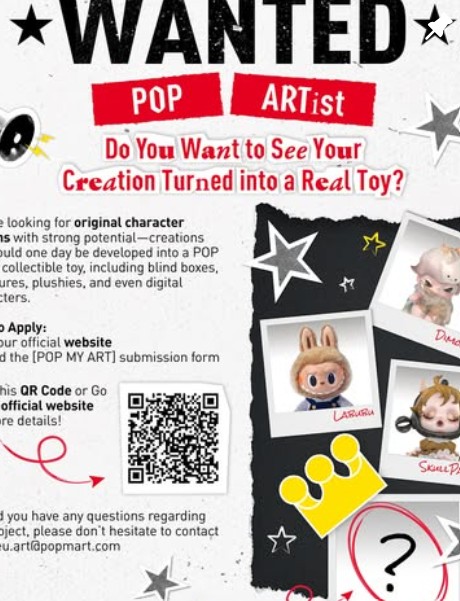
Back in September 2025, Pop Mart launched an open call for artists who could create “original character designs with strong potential. Artist ideas turned to concepts that can grow into toys, blind boxes, plushies, figures, or even digital collectables.”
The opportunity was restricted to artists who were legal residents of the UK or EU/EEA countries (subject to GDPR). It “welcomed individuals and collaborative teams alike, including illustrators, sculptors, 3D artists, and designers.” Applicants were required to provide a public portfolio link and a short introduction to their work.
According to the OpenCallFinder Instagram account, selected artists would receive:
- An official contract with POP MART
- Professional support to take their idea from initial concept to finished collectable
- Distribution through POP MART’s global business channels
- International media exposure and career development opportunities
Applications were accepted directly via email at eu.art@popmart.com or through Behance.
But it looks like POP MART is still looking for artists as of May 2026 and has posted what looks like a direct-to-consumer call for artists to submit their designs on its UK website and on its Instagram account:
However, creatives must look beyond the shops for opportunities, such as this one for a Senior Programmatic Media Specialist with carmaker BYD Europe (live at the time of writing).
What about work culture expectations?
To secure these assignments or projects, UK freelancers must adapt to an incredibly fast corporate rhythm.
When hiring goes through European agencies, the process remains fairly standard. Freelancers apply via LinkedIn or other job platforms and submit a portfolio. Or advertising agencies outsource to freelancers
Candidates could be asked to complete a quick (hopefully paid) test to prove they can deliver under tight deadlines. When taking on pre-hire task tests, stop giving away free advice since you can hook clients without giving away too much in consultations. Have a written agreement detailing the test brief, deadline, payment terms, and payment method.
However, once you are onboarded, be prepared for communication to move to apps like WeChat or Lark. This transition can leave some freelancers feeling out of their comfort zone, wondering what happened to the official email thread.
The other major adjustment is the pace of decision-making. Strategic directions can be rewritten overnight, so check your messages as soon as your morning alarm goes off!
