


Freelancers can earn more by exploiting AI agent gaps

Study finds AI struggles with 97.5% of real freelance work. We break down the gaps and how to profit from them
A new study from the Center for AI Safety (CAIS) and Scale AI reveals which types of work remain beyond AI’s reach—and how quickly that gap is closing.
Freelancers may take a sigh of relief. Artificial intelligence, as it stands today, still struggles to automate most real-world projects. Yet the study suggests it will be wise to keep informed and prepared as improvements and growing calls for regulation signal disruption ahead.
Current AI agents fail at most real-world projects
The newly released Remote Labor Index (RLI) is the first attempt to measure AI’s capabilities against actual economic work rather than isolated technical tasks.
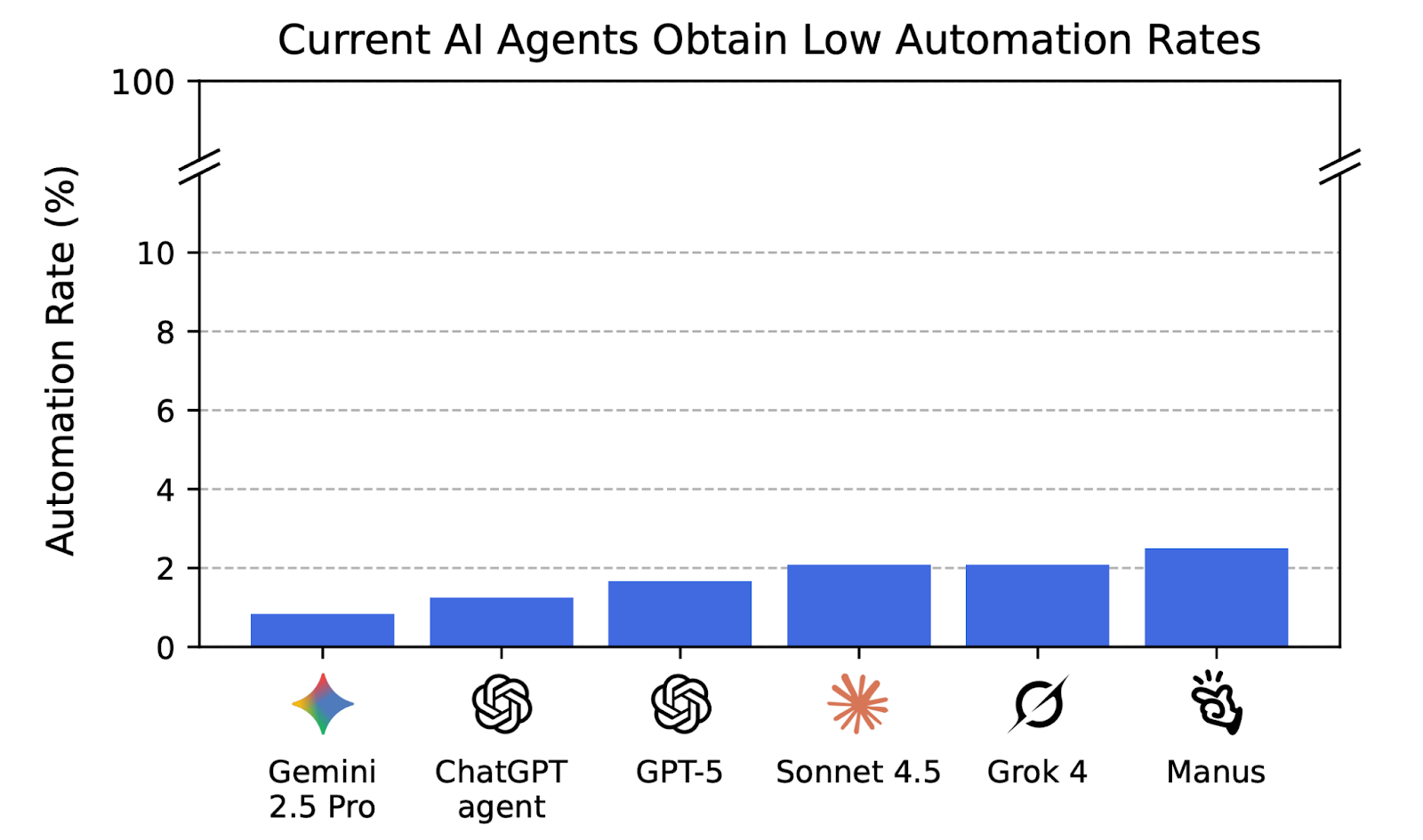
Testing AI agents on real computer-based projects from architecture, product design, video game development, and design professions, the benchmark found the most capable AI can fully automate just 2.5% of real work assignments. This figure contradicts the high scores AI achieves on technical benchmarks, exposing a gap between laboratory performance and economic impact that freelancers can exploit—for now.
Where AI fails and freelancers win
Based on the RLI findings, AI struggles most with projects requiring:
- Multi-tool workflows: A client needs a product mockup that requires Figma for design, Blender for 3D rendering, and After Effects for animation. AI can’t seamlessly move between tools or make creative decisions across platforms
- Undefined requirements: An architecture client says, “Design something that feels welcoming but professional” without specific parameters. AI needs explicit instructions; freelancers excel at interpreting vague briefs and asking the right questions
- Complex judgement calls: A video game developer needs enemy AI behaviour that “feels challenging but fair.” This requires playtesting, iteration, and subjective assessment that AI agents cannot perform autonomously
What the remote labour index means for freelance work
RLI collected real projects from professions that freelancers commonly work in, testing whether AI could complete them autonomously from start to finish. The benchmark differs from previous AI tests that measure specific capabilities like basic web browsing or coding in isolation. Freelancers working on complex, multi-step projects requiring contextual understanding, creative problem-solving, and professional judgement across different software tools retain an advantage over current AI systems, according to the research.
Steady improvement signals future disruption
The 2.5% automation rate hides a concerning trend for freelancers: AI agents show consistent improvement over time on the RLI benchmark. Whilst today’s AI cannot handle most economically valuable work, the research indicates capabilities are advancing steadily. Freelancers should monitor which project types AI masters first, as these will face pricing pressure and increased competition from automated alternatives before more complex work follows.
Large coalition demands superintelligence moratorium
Over 50,000 signatories—including five Nobel laureates, the two most cited scientists of all time, and political figures from across the spectrum—have signed an open letter calling for a ban on developing superintelligence until scientific consensus confirms it can be built safely and the public supports its creation.
The Future of Life Institute’s statement represents the largest and most politically diverse group ever to unite around AI safety concerns, signalling that policymakers may soon impose regulatory frameworks affecting how AI develops and deploys in commercial settings.
Statement on Superintelligence:
Context: Innovative AI tools may bring unprecedented health and prosperity. However, alongside tools, many leading AI companies have the stated goal of building superintelligence in the coming decade that can significantly outperform all humans on essentially all cognitive tasks.
This has raised concerns, ranging from human economic obsolescence and disempowerment, losses of freedom, civil liberties, dignity, and control, to national security risks and even potential human extinction.
The succinct statement below aims to create common knowledge of the growing number of experts and public figures who oppose a rush to superintelligence.
One of the supporters of the statement, Stuart Russell, Professor of Computer Science, Berkeley, Director of the Center for Human-Compatible Artificial Intelligence (CHAI), Co-author of the standard textbook ‘Artificial Intelligence: a Modern Approach ‘, was quoted:
This is not a ban or even a moratorium in the usual sense. It’s simply a proposal to require adequate safety measures for a technology that, according to its developers, has a significant chance to cause human extinction. Is that too much to ask?
Public opinion shifts towards AI caution
Polling released alongside the open letter reveals approximately two in three US adults believe superintelligence shouldn’t be created until proven safe and controllable. This public sentiment shift matters for freelancers because regulatory responses to AI risks could slow deployment of automation tools in certain sectors whilst accelerating it in others deemed lower risk. The consensus opinion forming around AI safety—previously dismissed by critics—now includes mainstream scientific and public support that typically precedes policy intervention.
What freelancers should do now
Critics of the open letter’s lack of specific implementation details and the difficulties of enforcing any moratorium include Dean Ball, a research fellow at the Mercatus Center. However, defenders such as Scott Alexander, a prominent writer on AI safety whose blog reaches thousands in the tech community, argue consensus statements create momentum for developing specific AI safety policies.
For freelancers, this debate matters less than the trajectory. AI, as we write this article, can’t replace most skilled work, but it’s improving while regulatory uncertainty grows.
Professionals should identify which aspects of their work AI struggles with most—complex judgement, multi-tool workflows, undefined requirements—and emphasise these capabilities to clients when efficiency gains remain available.
Don’t get left behind as AI reshapes freelance work.
Subscribe to The Freelance Informer newsletter for weekly insights on automation trends, which skills stay valuable, and how to position yourself ahead of the disruption.
Join 100,000+ freelancers and contractor hiring firms staying informed—sign up now.